

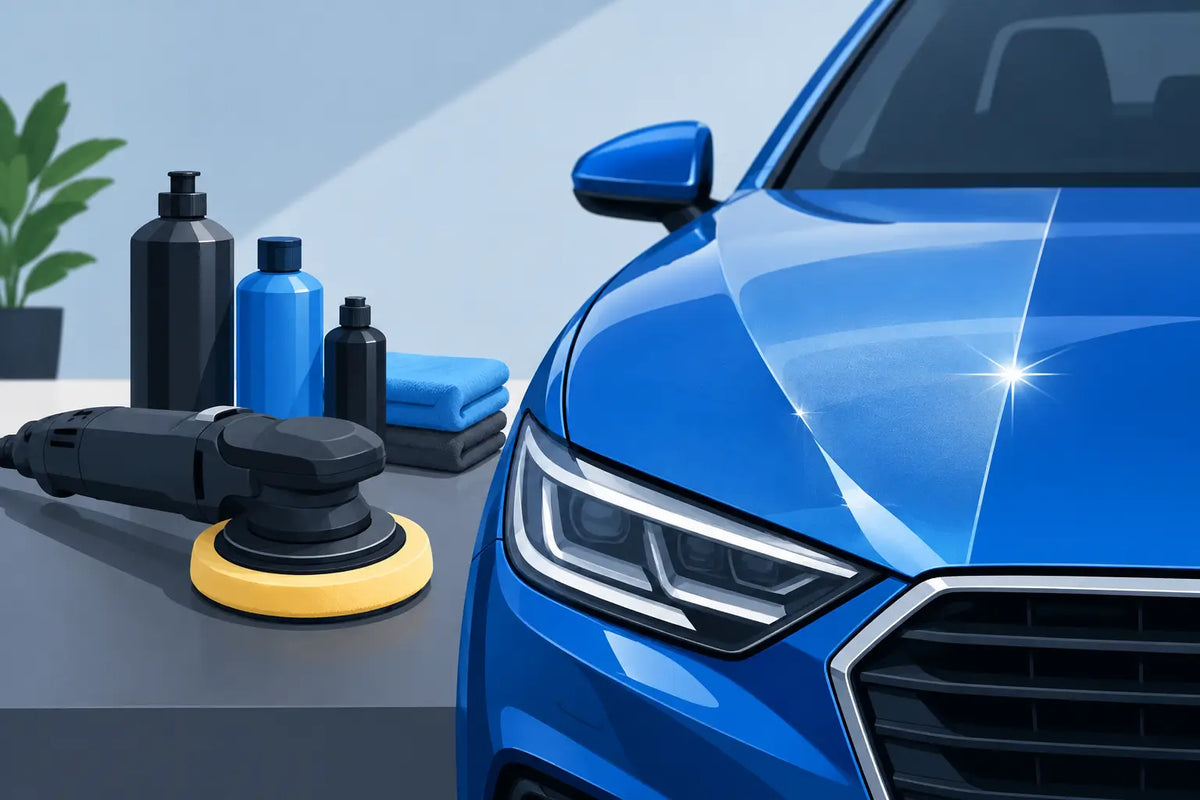
A proper car polish review is not a test of which bottle makes a panel look brightest for five minutes. It is a test of correction, control and repeatability. Can it remove the defects it claims to remove? Does it finish cleanly on real paint? Can you work it without dusting, sticking or wasting half the product on the pad?
That is the standard that matters, whether you are correcting a black daily driver on a Saturday or turning around several client cars a week. The best polish is not automatically the most aggressive, the most expensive or the one with the loudest claims. It is the one that gives the required result with the least unnecessary removal of clear coat.
What a car polish should actually do
Car polish is an abrasive product designed to level defects in the clear coat. Swirl marks, wash marring, light scratches, oxidation and sanding marks all sit at different depths. A polish removes a controlled amount of material to reduce or eliminate those defects, then refines the surface so the paint can reflect light cleanly.
That sounds simple. In practice, the result depends on the paint system, pad, machine, temperature, technique and inspection lighting. A compound that corrects quickly on a softer Japanese clear coat may need a firmer pad and more measured working cycle on hard German paint. There is no universal “one-step” result that applies to every vehicle.
A good formula gives you useful correction without making the process difficult. It should spread evenly, stay workable long enough to make a pass properly, wipe away without fighting you, and leave a finish that does not disguise defects with heavy fillers. Chemistry first. Hype last.
Car polish review criteria that separate performance from polish
The visible finish matters, but it is only one part of the assessment. A polish can look exceptional under workshop lights while masking remaining haze or micro-marring. Proper testing means checking the panel after an appropriate panel wipe, under more than one light source, and after the residue has been removed completely.
Cut and defect removal
Cut is the rate at which a polish removes defects. More cut is not always better. On thin, soft or previously corrected paint, excessive aggression is a liability. You want the least aggressive combination that achieves an acceptable correction level.
For a heavy-cut compound, assess how quickly it removes deeper wash damage and whether it can deal with isolated marks safely. For a medium polish, look for genuine correction of moderate swirls rather than an oily gloss that vanishes after preparation. For a finishing polish, the key question is whether it removes compounding haze and increases clarity without introducing fresh marring.
Do not judge cut in isolation. Pad choice changes everything. A cutting pad can make a medium compound behave much more aggressively, while a soft finishing pad can reduce effective correction dramatically. Review the system, not just the liquid.
Finish quality and clarity
A panel can be glossy and still be poorly refined. Gloss is broad reflected light; clarity reveals how sharply the paint reflects detail. On dark colours especially, the difference becomes obvious under a focused inspection light.
The strongest polishes combine correction with a clean finish. This reduces the number of stages needed, saves time and limits unnecessary clear-coat removal. But there is a trade-off. A true all-in-one product that cuts hard and finishes perfectly on every paint type is rare. Products marketed as one-step solutions can be highly effective, but only when the paint, pad and expectations match the job.
Working time, dust and wipe-off
The best correction product is of limited use if it turns a routine enhancement into a cleanup job. Dusting contaminates trims, shuts down pads and adds time. Short working time can force rushed passes. Sticky wipe-off can create the false impression of correction because residue remains on the paint.
A worthwhile polish should allow a controlled working cycle at sensible machine speeds. It should not need excessive product, and it should wipe away without constant pressure or repeated towels. Ambient conditions still matter. Humidity, panel temperature and pad saturation can change behaviour, so review performance across more than one panel before making a final call.
Fillers, oils and honest inspection
Some oils are useful for lubrication and workability. The issue is not the presence of oils. The issue is whether a product leaves enough residue to conceal defects and inflate the apparent finish.
After polishing, use a suitable paint preparation product and inspect again. If swirls return after the panel is cleaned, the polish has filled rather than corrected. That may be acceptable for a quick retail valet where temporary appearance is the agreed outcome. It is not acceptable when preparing paint for a ceramic coating or selling a correction service on measured results.
Pad cleanliness and product economy
Detailers should also review how a polish treats consumables. Does it clog the pad quickly? Does it need frequent blowing out? Does it sling at normal working speeds? A product that appears cheap per bottle can become expensive through wasted product, extra pads and slower turnaround.
Start with a primed pad, use small amounts after the first set, and clean the pad regularly. This gives a fairer view of the polish and prevents a saturated pad from being blamed on the formula.
Match the polish to the correction stage
The common mistake is buying by label alone. “Heavy cut”, “one step” and “finishing” are useful categories, not guarantees. Build the choice around paint condition and the required finish.
A heavily neglected vehicle may need a compound followed by a refinement stage. A well-maintained car with light wash marring may respond best to a medium polish on a polishing pad. A ceramic-coated car with minor defects may only need a fine finishing polish, or it may need no correction at all if the marks are in contamination rather than the coating.
Always begin with a test spot. Tape a manageable section, document the starting condition, make a controlled set of passes, then inspect after residue removal. If defects remain, change one variable at a time: pad, polish, pressure, machine speed or pass count. Changing everything at once teaches you nothing.
Paint-depth readings are equally valuable where available. They do not make correction risk-free, but they help establish whether the panel has room for further work and whether readings vary around edges, body lines or previous repairs.
Machine choice changes the result
A dual-action machine is the sensible starting point for most enthusiasts and remains a mainstay for professionals. It is forgiving, versatile and capable of excellent correction with the right pad and technique. Forced-rotation machines can increase correction on difficult paint but require more control. Rotary machines remain effective for experienced operators, particularly on severe defects, yet they raise the risk of heat build-up and holograms.
No machine fixes poor process. Keep the pad flat where possible, avoid dwelling on edges, use overlapping passes, and let the abrasive and pad do the work. Excessive pressure can stall a dual-action machine, overload the pad and generate inconsistent results.
What to expect from a one-step polish
One-step polishing is often misunderstood. It does not mean every scratch disappears in a single pass. It means improving the paint substantially while leaving it presentable enough that a second refinement stage is not required for the agreed standard.
For retail enhancement work, that can be the most commercially sensible approach. A one-step polish can remove a meaningful level of wash marring, restore gloss and prepare the panel for protection in a fraction of the time of a two-stage correction. For concours-level dark paint, severe defects or a coating installation where maximum clarity is the aim, a dedicated compound and finishing polish may still be the correct route.
The disciplined approach is to sell and deliver the level of correction the vehicle actually needs. Not every car needs perfection. Every car deserves an honest finish.
Protection comes after correction
Polish removes defects but does not provide durable protection unless it is specifically formulated as an all-in-one product. Once the paint is corrected and properly prepared, protect it with a sealant, wax or ceramic coating suited to the vehicle’s use and maintenance plan.
For coatings, preparation is non-negotiable. Polishing oils and residue can interfere with bonding, so complete the manufacturer-recommended preparation process before application. A clean, corrected surface gives the coating its best chance to perform and makes future washing safer and easier.
Liquid Laboratories approaches this workflow as a system: wash safely, decontaminate, correct only what needs correcting, prepare thoroughly, then protect. Fewer random products. Better process control.
The verdict: judge polish by the job, not the label
The right polish earns its place through predictable correction, clean refinement, manageable working behaviour and honest inspection results. It should make the job faster without encouraging shortcuts, and it should let you stop as soon as the required standard is reached.
Before opening the next bottle, assess the paint, run a test spot and inspect without residue on the panel. That one disciplined habit will improve more corrections than any marketing claim ever will.
Share:
How to Remove Water Spots Safely From Paint
Detailing Business Margins: What Actually Matters