
A vehicle can look clean, feel dry and still be contaminated. Run a clean hand across the lower doors, rear bumper or boot lid and the roughness tells the real story. An iron remover targets the embedded ferrous particles that shampoo, traffic film remover and snow foam are not designed to dissolve.
This is not a cosmetic extra for social media wash videos. Ferrous fallout affects how paint feels, how wheels clean, how well a polishing stage performs and how reliably protection bonds. Used at the right point in the process, it removes a contaminant rather than hiding it. Zero hype. Pure chemistry.
What an iron remover actually removes
Iron contamination is usually airborne brake dust and industrial fallout. Hot metallic particles are released during braking, then lodge into paintwork, wheels, glass and plastic trim. Rail transport, construction activity and urban driving can add further fallout. It is often concentrated around wheel arches, lower panels, the rear of the vehicle and horizontal surfaces, but no exterior surface is completely exempt.
Once embedded, those particles oxidise. On light-coloured paint they can eventually present as small orange or brown spots. On darker paint, they may be harder to see, but the gritty feel remains. Leaving them in place creates a compromised surface before you even consider wax, sealant or ceramic coating.
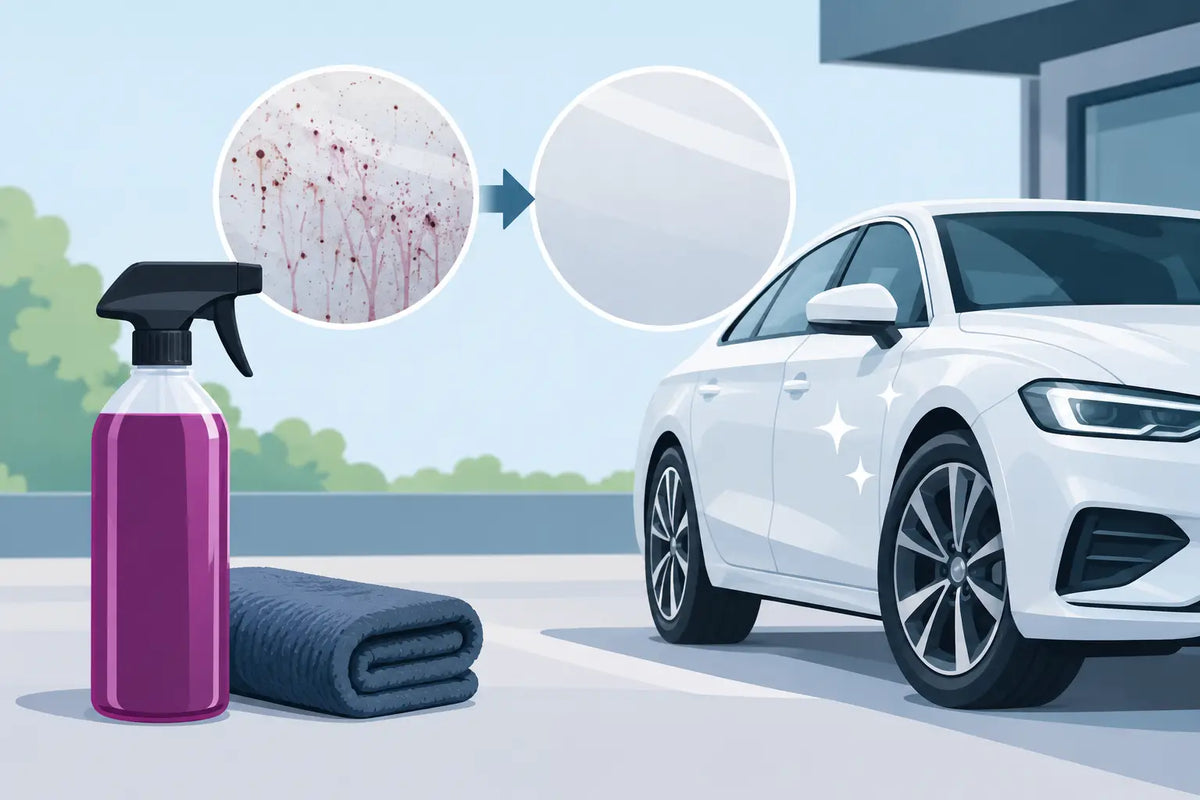
A quality fallout remover uses reactive chemistry to break down ferrous contamination. The familiar colour change - usually purple or deep red - is the reaction occurring as the product complexes with iron. It is useful visual feedback, not the reason the product works. A dramatic bleed effect does not automatically equal better cleaning. Dwell time, safe working behaviour and thorough rinsing matter more.
Why shampoo alone cannot do this job
pH-neutral shampoo is built to lift routine road grime while preserving existing protection. It provides lubrication and safely cleans loose dirt. It is not intended to chemically dissolve bonded metal particles.
The same applies to a pre-wash. Snow foam and traffic film removers reduce the abrasive dirt load before contact washing, which is essential, but they address different contamination. They prepare the vehicle; they do not replace chemical decontamination.
Clay can remove fallout mechanically, although it does so by dragging contamination from the surface. That makes it useful where bonded contamination remains, but it also introduces friction and can mar softer paint. An iron remover first reduces the ferrous load chemically. The clay stage becomes quicker, cleaner and less aggressive. On well-maintained vehicles, chemical decontamination may leave so little residue that claying is unnecessary outside correction work.
When to use an iron remover
There is no fixed calendar interval that suits every vehicle. A weekend car stored indoors and driven gently through rural roads will not build contamination like a daily driver parked near a railway line or used through a winter motorway commute.
For protected enthusiast cars, use an iron remover when the paint begins to feel rough after washing, before applying fresh protection, or at a planned seasonal decontamination wash. For daily drivers, every three to six months is a sensible starting point. Professional detailers should assess the vehicle rather than apply a routine blindly. Heavy wheel fallout, neglected lower panels and preparation for polishing all justify its use.
It is particularly valuable before applying a ceramic coating, sealant or wax. Protection can only bond properly to what is actually exposed. Applying a coating over ferrous particles means protecting contamination rather than paint.
Do not reach for it automatically at every maintenance wash. Frequent use is not inherently wrong when the formula is surface-safe and used correctly, but it can be unnecessary product use on a lightly driven, well-maintained vehicle. Precision beats habit.
The correct place in the wash process
Iron removal works best on a vehicle that has already had the heavy dirt removed. Applying it to a heavily soiled panel wastes product and makes it harder to see where contamination is reacting.
Start with a thorough pre-rinse, then apply your chosen pre-wash or snow foam as appropriate and rinse again. At this point, apply the iron remover to cool, wet or towel-damp exterior surfaces according to the product directions. Wheels can be treated at the same stage, provided they are cool and the wheel finish is suitable for the formula.
Allow the product to dwell while the reaction takes place. Do not let it dry. In typical British conditions, a few minutes is usually enough, but temperature, wind, direct sun and contamination level all change the working window. Work panel by panel in warm weather rather than covering the whole vehicle and hoping for the best.
Rinse thoroughly, then move into the contact wash using a pH-neutral shampoo and clean wash media. If the vehicle is receiving correction or long-term protection, inspect the paint after drying. Only then decide whether clay treatment, tar removal or polishing is still required.
Wheels need their own judgement
An iron remover is highly effective on wheels because brake dust is ferrous by nature. However, it is not automatically a complete wheel-cleaning system. It will not remove every type of tyre dressing sling, oily grime, baked-on road film or mineral deposit.
For regularly maintained wheels, an iron remover may be all that is needed after a rinse. For neglected wheels, use it as part of a controlled process alongside a suitable wheel cleaner, agitation where necessary and a dedicated brush. Never treat the colour reaction as permission to stop rinsing. Reaction residue, loosened dirt and cleaner all need to be flushed away properly.
Conditions that decide the result
Technique protects surfaces and gets the most from the chemistry. The product should be used out of direct sunlight, on cool panels and never allowed to dry. These rules are not cautious marketing. Heat accelerates evaporation, shortening dwell time and increasing the risk of staining or residue on sensitive finishes.
Pay attention to vulnerable areas. Stone chips, unpainted brake components, damaged lacquer, polished metal and unknown aftermarket wheel finishes deserve more care. Test an inconspicuous area if the surface condition is uncertain. A professional does not assume compatibility because a product worked safely on the last ten vehicles.
Do not use a fallout remover in a confined space with poor ventilation. Wear gloves, avoid inhaling mist and keep the product away from children and pets. Most modern formulations are designed for practical, routine use, but they remain active chemical products. Treat them accordingly.
Common mistakes that waste product
The first mistake is applying iron remover to a dry, hot, dirty vehicle. Dirt blocks contact with contamination, heat shortens the dwell window and dryness can make coverage uneven. Pre-clean first.
The second is confusing a colour change with completed decontamination. Purple bleeding shows that the chemistry has found iron. It does not tell you whether tar, mineral deposits, tree sap or bonded traffic film are still present. Each contamination type needs the correct chemistry.
The third is leaving the product to dry because “more dwell time must be better”. It is not. Once the liquid has evaporated, the process has moved beyond productive dwell and into avoidable risk. Rinse while wet, then repeat a controlled application if the vehicle is heavily contaminated.
Finally, avoid treating every rough surface as iron fallout. If the panel still feels contaminated after a wash and iron treatment, inspect before escalating. Tar feels raised and sticky. Water spotting is mineral-based. Overspray, sap and industrial film each require different approaches. Correct diagnosis prevents needless polishing and protects the finish.
Iron removal before protection
The closer you get to a coating or correction stage, the less room there is for shortcuts. Paint should be clean, chemically decontaminated where needed, free from visible tar and properly prepared for the protection system being installed.
For a maintenance sealant, an iron removal stage can improve surface cleanliness and restore the smoothness that makes drying easier. Before machine polishing, it reduces the chance of dragging metal particles beneath a pad. Before ceramic coating, it forms part of the preparation discipline that supports consistency, appearance and durability.
Liquid Laboratories approaches decontamination as a system, not a shelf of overlapping bottles. Use the product that addresses the contamination in front of you, in the correct order, and give it the conditions it needs to work.
A clean finish should feel as good as it looks. If the paint is still gritty after the wash, do not cover the problem with gloss products. Remove the contamination first, then protect the surface you have actually prepared.
Share:
All Purpose Cleaner Dilution for Car Care
Polish Versus Compound: Which Comes First?