

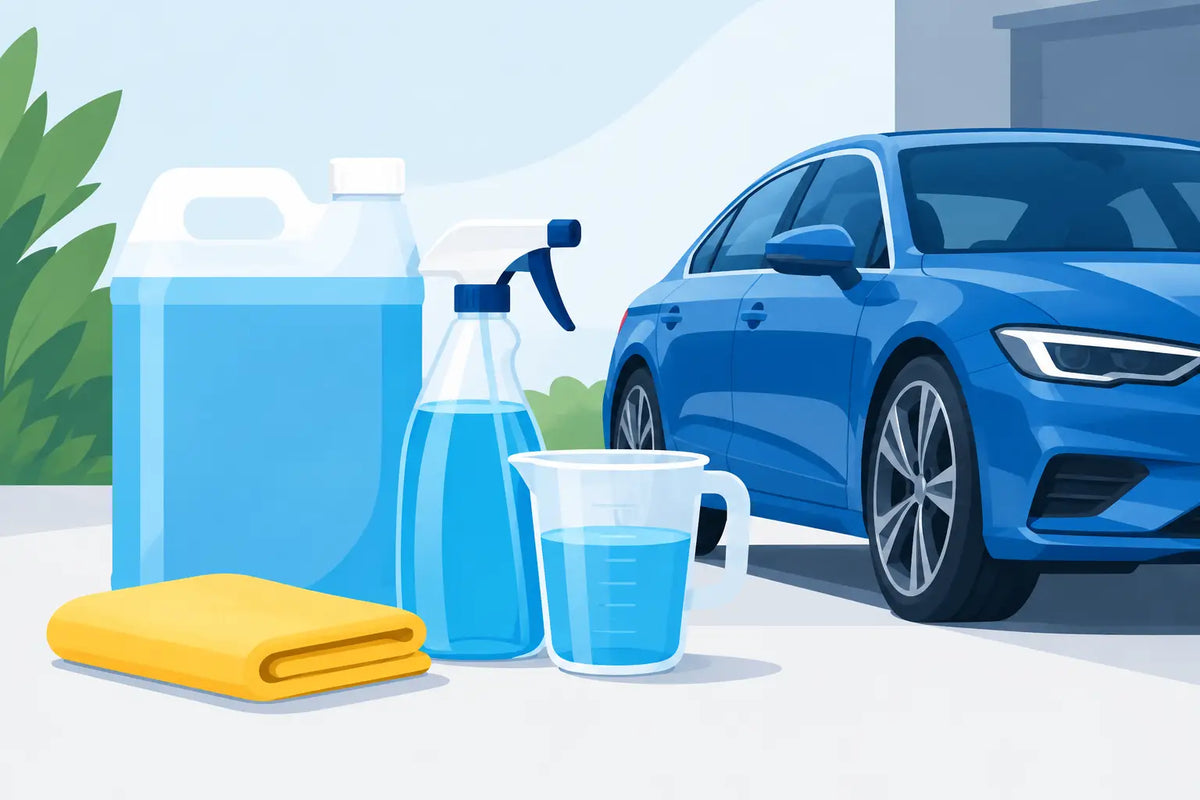
A 1-litre trigger bottle can either become your most efficient detailing tool or the reason a previously clean interior looks patchy. All purpose cleaner dilution determines which one it is. Too weak, and you waste time scrubbing traffic film, tyre browning and interior grime. Too strong, and you raise the risk of staining, drying out trim, marking sensitive surfaces or leaving stubborn residue.
The answer is not to use the strongest mix for every job. Good detailing is controlled chemistry. Match the concentration, dwell time and agitation to the contamination in front of you.
Why all purpose cleaner dilution matters
An all purpose cleaner, often shortened to APC, is designed to break down a broad range of organic and oily soils. Think mud, food spills, body oils, old dressing residue, oily deposits and general grime. That versatility is useful, but it does not mean every surface needs the same strength.
A stronger solution increases cleaning power. It can also increase the chance of pulling oils from plastics, dulling delicate interior finishes, affecting weak trim dye, or stripping protection from surfaces that only needed a light clean. On the other hand, an unnecessarily weak solution can encourage aggressive brushing. That mechanical action can cause its own damage.
The target is the lowest effective concentration. It is faster in the long run, safer on the vehicle and more economical for a professional operation. Chemistry made clear: use enough product to release the soil, then let suitable brushes, microfibre and controlled rinsing do the rest.
Read the ratio before filling the bottle
Dilution ratios are commonly written as 1:10, 1:20 or 1:50. In most detailing contexts, this means one part product to the stated number of parts water. A 1:10 mix is therefore one part concentrate plus ten parts water, making eleven parts in the finished solution.
However, ratio conventions are not universal. Some brands refer to a percentage of product in the final solution, while others use ratios based on the total finished volume. Never assume. Read the product instructions and stick to the manufacturer’s convention, particularly when working with concentrated alkaline cleaners.
For a standard 1-litre bottle, assuming the ratio means product to water, the practical figures are straightforward:
- At 1:10, use roughly 91 ml of product and 909 ml of water.
- At 1:20, use roughly 48 ml of product and 952 ml of water.
- At 1:50, use roughly 20 ml of product and 980 ml of water.
- At 1:100, use roughly 10 ml of product and 990 ml of water.
Label every bottle with the product name, ratio and intended use. This is not overkill. It prevents a strong wheel-arch cleaner being used on an interior door card and lets every person in a detailing unit work to the same standard.
Choose the ratio by soil load, not habit
There is no universal APC ratio for a car. The correct dilution depends on the cleaner itself, the surface material, existing protection, temperature and how long the contamination has been sitting there. Product label guidance always comes first, but a sensible working system looks like this.
Light interior maintenance
For regular interior cleaning, a mild dilution is usually enough. A ratio around 1:30 to 1:50 is often suitable for plastic trims, vinyl, rubber mats and lightly soiled fabric, provided the product is approved for those surfaces.
Apply to a brush or microfibre rather than saturating the panel. Work small areas, lift the soil with a clean towel and avoid flooding switches, speaker grilles, seams and electronic controls. A cleaner that dries in texture can leave water marks or residue, especially on piano-black trim and soft-touch finishes.
For leather, do not treat APC as the default answer. Modern automotive leather is commonly coated, but coatings vary and perforated, worn or repaired leather needs extra care. Use a dedicated leather cleaner where appropriate, or test a mild approved dilution in an inconspicuous area first.
Heavier interior grime
Door shuts, rubber mats, pedal areas and heavily handled plastics may need a stronger mix, often around 1:10 to 1:20 depending on the product. This is where APC earns its place. The soil is usually concentrated, and a dedicated brush gives the cleaner a chance to work into grain and texture.
Do not let strength replace technique. Short dwell time, gentle agitation and immediate removal are safer than soaking an area and returning once the product has dried. If the contamination remains after one controlled pass, repeat the process rather than immediately doubling the concentration.
Tyres, arches and exterior plastics
Road film, tyre browning and old dressings are heavier jobs. A stronger dilution may be appropriate, commonly in the 1:5 to 1:20 range where the formula permits it. But tyres, wheel arches and exterior plastics are not identical surfaces. Tyre rubber can hold embedded contamination, while faded unpainted trim may react differently to alkaline products.
Work out of direct sunlight on cool surfaces. Apply evenly, allow a brief dwell, agitate with the right brush and rinse thoroughly. Never allow a strong cleaner to dry. This is especially relevant on textured black trim, bare aluminium, polished metal and previously compromised surfaces.
Engine bays and painted areas
An engine bay is not a licence to use maximum strength. Modern bays contain sensitive plastics, labels, electrical connections and varied metal finishes. Use the least aggressive effective mix, control the application and avoid pressure washing vulnerable areas.
For painted door shuts and general exterior grime, a pH-neutral shampoo, pre-wash or traffic-film remover may be more appropriate than APC. An APC can clean paint safely at a suitable dilution when the formula allows, but it is not automatically the best first choice. Product selection matters as much as dilution.
Bottle maths that keeps work consistent
Large bottles are useful for trade work, but the same calculation applies at any volume. Divide the total finished volume by the total number of parts. For a 1:20 ratio, there are 21 parts in total. In a 500 ml bottle, 500 divided by 21 gives about 24 ml of concentrate, with water making up the remainder.
Measuring cylinders, marked mixing bottles or a small syringe remove the guesswork. A capful is not a reliable unit because caps vary and product viscosity varies. That inconsistency becomes expensive when you are mixing several bottles every week.
Add water first if the manufacturer directs it, then measure in the concentrate and mix gently. This reduces excessive foaming and makes it easier to hit the final volume. Use clean bottles only. Residue from a previous acidic wheel cleaner, solvent product or dressing can change how a new solution behaves.
Dwell time, agitation and temperature change the result
Dilution is only one part of cleaning power. A correctly diluted APC needs contact time to loosen soil, but more dwell is not always better. Once a cleaner begins to dry, its residues can become harder to remove and the risk to sensitive materials rises.
Temperature matters too. A mix that performs perfectly in a cool workshop can flash-dry on a black panel in summer sun. Warm surfaces also make it harder to judge whether a mark is remaining contamination, cleaner residue or surface damage. Move the vehicle into shade where possible and reduce working area size when conditions are hot.
Agitation should be proportionate. Soft interior brushes for textured plastics and fabrics, dedicated tyre brushes for rubber, and clean microfibres for smooth trim. Dirty brushes simply redeposit grime. Keep tools separated by task. The brush used on a tyre should never find its way into an interior.
Test first when the surface is unknown
Older vehicles, aftermarket trim, repaired leather, dyed plastics, faded badges and poor-quality resprays deserve caution. So do heavily soiled vehicles where grime may be hiding existing damage. Test a discreet area with the intended dilution, remove the product properly and inspect once dry.
If a surface reacts, do not keep chasing the result with more product. Step back. A dedicated cleaner, a milder mix or a different method may be required. Professional results come from recognising the limits of a chemical, not forcing one bottle to solve every problem.
A properly labelled, accurately mixed APC bottle gives you control at the start of every job. Build your ratios around the vehicle, the soil and the product instructions, then let disciplined process deliver the finish.
Share:
Best Car Polishes for Gloss Without Guesswork
When an Iron Remover Belongs in a Proper Wash