

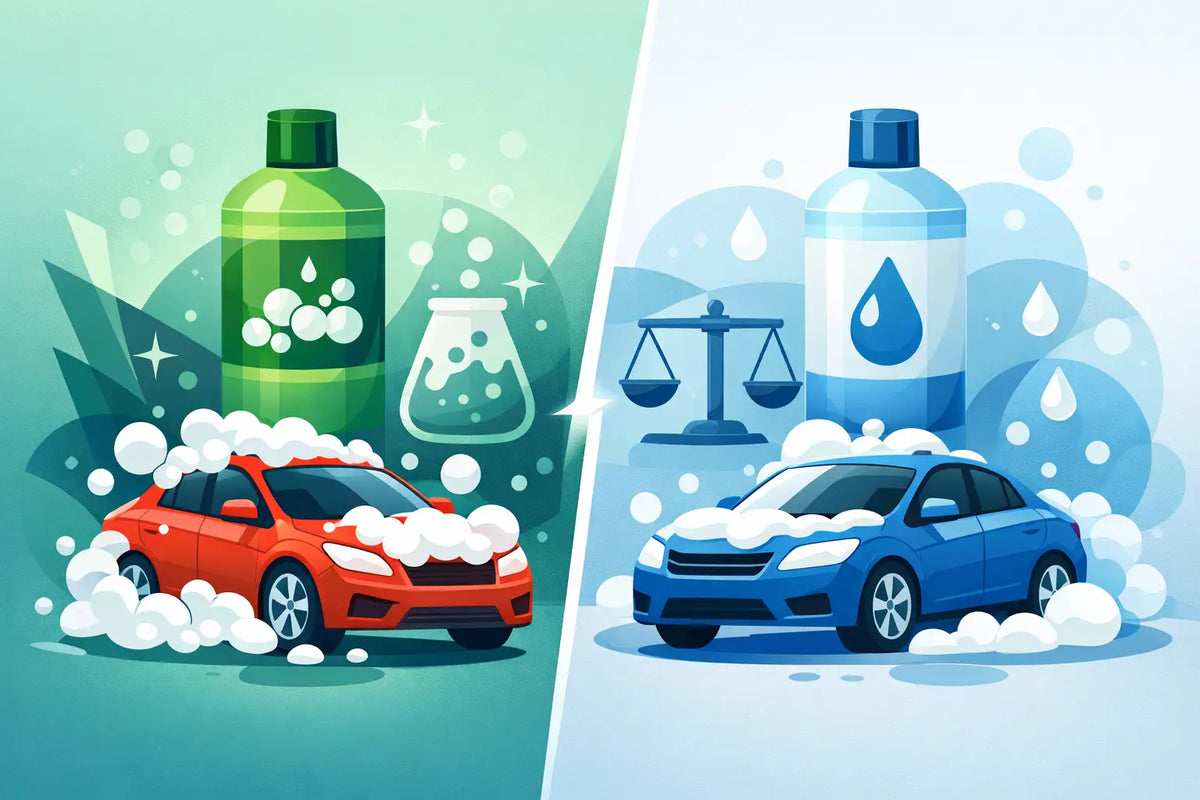
A wash shampoo is not just there to make a bucket foam. Its pH, surfactant package and dilution determine how it deals with road film, old protection and the finish you are trying to preserve. In the alkaline shampoo vs neutral shampoo debate, the right answer is rarely about which formula is ‘best’. It is about matching cleaning power to the vehicle’s condition and the protection already on it.
A neglected daily driver covered in winter grime needs a different approach to a freshly coated car receiving a careful maintenance wash. Use too little cleaning strength and traffic film remains behind. Use too much, too often, and you can reduce the water behaviour, gloss and longevity of a wax or sealant. Chemistry made clear.
What pH means in car shampoo
The pH scale measures how acidic or alkaline a water-based product is. A pH of 7 is neutral. Below 7 is acidic; above 7 is alkaline. The scale is logarithmic, so a move of one pH unit represents a significant change in chemical behaviour, not a minor adjustment.
For car care, pH matters because soil is not one thing. Road film commonly contains oily residues, carbon, salt, mineral deposits and organic contamination. Alkaline chemistry is particularly useful for breaking down oily, traffic-film-heavy dirt. Neutral shampoo is designed to clean more gently while offering good lubrication and controlled rinsing.
That said, pH is only one part of the formula. A neutral product can still clean extremely well if its surfactants, wetting agents and concentration are properly engineered. Equally, a high-pH product can be badly balanced, leave residue or feel harsh if the formula relies on brute force rather than chemistry. Never judge a shampoo by one number on a label.
Alkaline shampoo: when stronger cleaning earns its place
An alkaline shampoo is formulated above pH 7, often with surfactants and builders chosen to tackle heavier organic grime and traffic film. In practical terms, it is useful when a vehicle has not been maintained closely, has been driven through poor weather, or needs a deeper reset before protection work.
It can reduce the need for aggressive contact washing because more contamination is softened and lifted during the wash process. That matters. Less pressure through the wash mitt means less opportunity to grind dirt across clear coat.
An alkaline shampoo is not automatically a protection stripper. The outcome depends on its pH, dwell time, concentration, water temperature and the type of protection on the vehicle. Durable ceramic coatings generally tolerate occasional alkaline cleaning well, while traditional waxes and some spray sealants may show weaker beading after repeated strong washes. The protection may not be completely gone, but its hydrophobic behaviour can be diminished or masked by residue and remaining grime.
Use alkaline shampoo with intent. It is a strong option for periodic deep cleaning, end-of-winter maintenance, fleet work and vehicles with a clear build-up of road film. It is not the default answer for every weekly wash simply because the label promises more cleaning power.
Where alkaline shampoo can go wrong
Over-concentration is the usual mistake. More product does not equal a better wash. It can make rinsing harder, affect trim appearance and unnecessarily challenge existing last-stage protection.
It is also poor process to use alkaline shampoo as a substitute for a proper pre-wash. If the lower panels are loaded with grit, start with a suitable pre-wash and thorough rinse. Shampoo should support the contact wash, not carry the entire burden of decontamination.
Neutral shampoo: the maintenance wash standard
A pH-neutral shampoo sits close to pH 7 and is the sensible choice for routine washing of protected paintwork. It is designed to remove normal wash-cycle dirt while being compatible with waxes, sealants and ceramic coatings when used correctly.
For a coated vehicle, this is usually the right starting point. The coating should provide the chemical resistance and easy-clean behaviour; the shampoo should clean without constantly forcing the surface through a heavy reset. A well-made neutral shampoo also prioritises lubricity. That slick wash solution helps the mitt glide over paintwork rather than drag across it.
Neutral does not mean weak. On a regularly maintained vehicle, a quality neutral shampoo should remove everyday road grime efficiently after a proper pre-wash. If it is failing every time, the problem may be the wash routine, the dilution ratio, hard-water residue or the fact that the vehicle needs a deeper clean rather than another maintenance wash.
Protection-friendly does not mean process-proof
A neutral shampoo cannot protect paintwork from poor technique. Washing in direct sun, using a contaminated mitt, working with dirty water or skipping the pre-wash will still increase the risk of marring.
It also will not revive a protection layer that has genuinely degraded. If water behaviour is flat after a full clean and chemical decontamination, adding more shampoo will not solve it. Inspect the surface, remove bonded contamination where needed, then apply an appropriate protection product.
Alkaline shampoo vs neutral shampoo: the real trade-off
The decision is a balance between cleaning strength and maintenance safety. Alkaline shampoo gives you more bite against stubborn traffic film. Neutral shampoo gives you a controlled, repeatable wash that is kinder to existing protection.
For most enthusiasts and professional detailers, the strongest workflow is not choosing one camp. It is keeping both options available and using each at the correct point. A protected car washed every one or two weeks should spend most of its life with neutral shampoo. A vehicle returning after months of motorway mileage, winter salt or inconsistent care may justify an alkaline wash before protection is assessed or topped up.
Think about the finish, not only the dirt. Ceramic-coated vehicles can normally accommodate occasional alkaline washing, particularly when contamination is reducing hydrophobicity. Wax-protected paintwork deserves more caution, especially if the wax is near the end of its service life. Matte paint, satin vinyl and sensitive finishes should always be treated according to the protection manufacturer’s guidance, with unnecessary chemical strength avoided.
Build the choice into the wash process
Start by assessing the vehicle before opening a bottle. If the paint is lightly dusty with normal road grime, use a pre-wash, rinse thoroughly and follow with neutral shampoo. This is the disciplined maintenance route.
If the vehicle has grey traffic film, oily lower panels and weakened water behaviour, use a stronger pre-wash first. An alkaline shampoo may then be appropriate for the contact stage, provided it is diluted accurately and not allowed to dry on the surface. Rinse completely, then evaluate the protection rather than assuming it has failed.
Four checks keep the decision simple:
- How heavily contaminated is the vehicle?
- What protection is currently on the paint?
- Is this a routine maintenance wash or a reset wash?
- Has the product been diluted exactly as specified?
Do not confuse shampoo with a pre-wash
This distinction saves time and paintwork. A pre-wash is intended to loosen and remove loose contamination before contact. Snow foam, traffic-film removers and citrus pre-washes each have a place depending on the soil load. Shampoo provides lubricated contact cleaning once the dangerous loose grit has been reduced.
Trying to make a neutral shampoo behave like a traffic-film remover usually leads to excessive rubbing. Trying to make an alkaline shampoo replace every pre-wash step can lead to overuse. The system works when each chemical has one clear job.
Liquid Laboratories approaches wash chemistry from that position: controlled products, correct dilution and no unnecessary steps. The target is not the most aggressive wash possible. It is a clean surface with protection performing as intended.
The practical choice
Choose neutral shampoo for regular maintenance, especially on freshly protected or consistently cared-for vehicles. Choose alkaline shampoo when the contamination level justifies the added cleaning strength, then return to a neutral wash routine once the finish is back under control.
The best shampoo is the one that removes the dirt in front of you without asking the paintwork, trim or protection to absorb more chemical stress than necessary. Read the surface, measure the dilution and let the process do the work.
Share:
How to Clean Car Interiors Without Causing Damage
Touchless Pre Wash Process: Clean Before Contact