

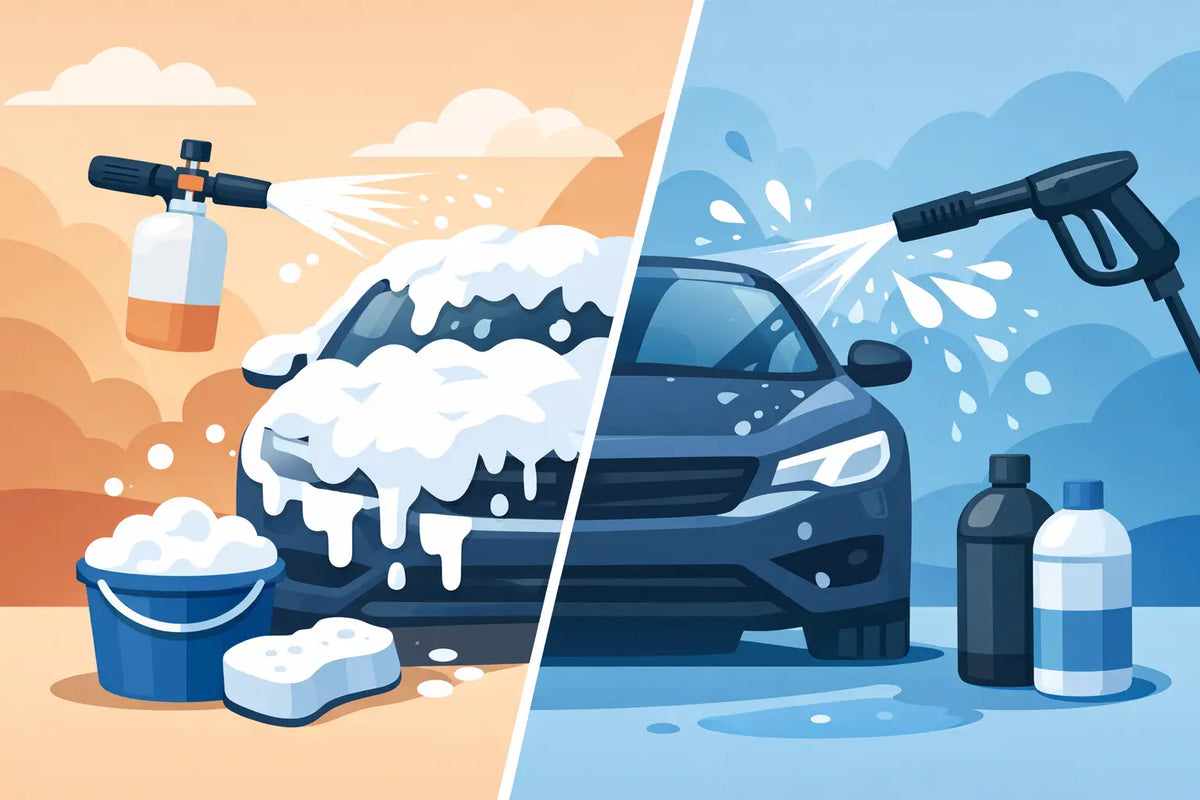
If you are still treating snow foam vs pre wash as the same step in different packaging, you are leaving cleaning power on the table. They can work together, but they do not do the same job, and choosing the wrong one for the dirt level, season or protection setup will affect both wash safety and final results.
Snow foam vs pre wash: the real difference
The cleanest way to understand it is simple. A pre wash is the chemistry that starts breaking down traffic film, road grime, oily contamination and stubborn dirt before you touch the paint. Snow foam is usually the delivery format that lays product on the surface as a visible blanket, extending dwell time and helping loosen contamination.
That distinction matters. Pre wash is about chemical cleaning strength. Snow foam is often about coverage, cling and lubrication before the contact wash stage. Some snow foams have meaningful cleaning ability. Some are mainly surface-softening and presentation. Some pre wash products can be applied through a pump sprayer and outperform a thicker foam on genuinely dirty vehicles.
So when people ask whether snow foam or pre wash is better, the honest answer is that they are not direct substitutes in every case. One describes function. The other often describes form.
What a pre wash is designed to do
A proper pre wash is built to remove as much contamination as possible before a mitt goes near the paint. That means targeting the grime you pick up in normal road use - diesel residue, winter salt, traffic film, greasy build-up around the lower panels, and the layer of dirt that shampoo alone will not shift efficiently.
For a professional detailer, that is not a minor gain. It means less contact, less risk of marring and faster wash stages on heavily used vehicles. For an enthusiast maintaining a coated car, it means preserving the finish rather than grinding road film across it because the pre-cleaning stage was too weak.
Pre wash chemistry can be pH neutral, alkaline or somewhere in between depending on the job. That is where nuance matters. A stronger alkaline formula may cut through winter grime far better than a gentle maintenance foam, but it may also be excessive for a lightly dusty weekend car with fresh protection. Better chemistry is not always more aggressive chemistry. It is chemistry that matches the contamination.
Where snow foam fits in
Snow foam earns its place when you want broad, even coverage and dwell. Through a foam lance, it coats the vehicle quickly and visibly, which makes application controlled and repeatable. On maintenance washes, especially on protected vehicles, that can be enough to soften surface dirt and lift a surprising amount before rinse-off.
It also helps you see where product has been applied and whether it is dwelling evenly. That sounds basic, but consistency matters. If you are washing multiple vehicles a day or maintaining a ceramic coated car to a set standard, repeatability is part of performance.
The problem is that snow foam has been oversold for years as if thicker foam automatically means stronger cleaning. It does not. Dense shaving-cream style foam may look impressive on social media, but cling alone is not a cleaning metric. If the chemistry is mild, it remains mild, no matter how well it blankets the panels.
Snow foam vs pre wash in real-world conditions
On a lightly dusty car in spring or summer, a quality snow foam may do enough to loosen contamination before your hand wash. If the vehicle is protected, garaged and not seeing motorway miles every day, that approach can be efficient and safe.
On a daily driver in February, it is a different conversation. Road salt, oily film and lower-panel grime usually need more than a cosmetic layer of foam. That is where a dedicated pre wash earns its keep. Applied correctly, it attacks the contamination that causes wash marring and drags through your wash media.
This is why experienced detailers rarely judge the pre-clean stage by how it looks. They judge it by what is left after rinsing. If the vehicle still carries a bonded-looking grey film across the sills, rear end and front bumper, the chemistry was not strong enough for the job.
Can you use both together?
Yes, and in many cases you should. A dedicated pre wash followed by snow foam is often the smarter process when the vehicle is properly dirty. The pre wash handles the heavier contamination, especially on the lower sections and traffic-film zones, while the foam adds dwell and helps carry loosened dirt away before the contact stage.
Order matters. In most workflows, the stronger cleaning step goes on first where needed, then snow foam is layered over or used as a separate second pre-clean stage depending on product design. That said, product compatibility matters. Not every formula is meant to be stacked, and overloading the surface with multiple chemicals without understanding dwell time or panel temperature is not good technique. Precision beats theatre.
For maintenance details, using both every time may be unnecessary. If the car is only lightly soiled, one well-chosen pre-cleaning product can be enough. More steps do not automatically mean better detailing.
Which removes more dirt?
If we are speaking plainly, a dedicated pre wash usually removes more meaningful contamination than a standard snow foam. That is because it is developed with cleaning strength as the main priority, not foam output.
There are exceptions. Some modern snow foams are far better cleaners than the category used to be, and some mild pre wash products are intentionally gentle for waxed or coated cars. But if your goal is maximum dirt removal before contact, especially on neglected or winter-driven vehicles, pre wash is usually the more effective tool.
The trade-off is that stronger cleaning products need correct dilution, sensible dwell times and an understanding of the surface you are working on. Used badly, any chemistry can underperform or create problems. Used correctly, a proper pre wash saves time and reduces risk.
What about waxes, sealants and ceramic coatings?
This is where the internet usually loses discipline. People speak as if one pre-clean product will strip everything and another will never affect protection. Reality is less dramatic.
A pH-neutral snow foam is generally a safer maintenance choice for routinely cleaned, protected vehicles. It is unlikely to interfere with a healthy coating or quality sealant when used correctly. A stronger alkaline pre wash may reduce the performance of weaker last-step products over time, especially if overused or mixed too heavily, but that does not make it the wrong choice. If the car is genuinely dirty, preserving grime to protect a failing wax layer is not a serious wash strategy.
Ceramic coated vehicles often benefit from stronger pre-cleaning than owners expect. Coatings still collect road film. Hydrophobic behaviour is not the same as a self-cleaning surface. A well-formulated pre wash can restore the coating’s behaviour by removing the contamination masking it.
How to choose the right option
Start with the dirt, not the label. If the car has light dust, fresh protection and regular maintenance, snow foam may be enough as your pre-contact stage. If it has seen poor weather, motorway use, farm roads or weeks of neglect, reach for a dedicated pre wash.
Then think about workflow. Mobile detailers and busy trade users may prefer a targeted pre wash through a sprayer because it is fast, controlled and effective where contamination is worst. Enthusiasts washing at home may prefer snow foam for full-vehicle coverage and ease of use. Neither approach is automatically better. The right one is the one that removes the most dirt with the least unnecessary contact.
Finally, judge the product by outcome, not marketing language. Thick foam, bright colours and strong fragrance are not proof of performance. Cleaning ability, rinse behaviour, panel safety and consistency are.
The mistake that causes most confusion
The biggest mistake is expecting one product to handle every vehicle, every season and every protection type equally well. That is not how chemistry works. The right pre-clean setup in July may be underpowered in January. The ideal maintenance foam for a coated weekend car may be the wrong answer for a neglected family hatchback.
That is why serious detailing brands build systems, not gimmicks. Each stage should have a clear job. At Liquid Laboratories, that mindset is simple - zero hype, pure chemistry. If a product sits in the wash process, it should earn that position through measurable performance, not just foam for foam’s sake.
If you want fewer swirls, cleaner rinse stages and a wash process that actually matches the condition of the vehicle, stop asking which sounds better and start asking what the contamination requires. That is where better detailing starts.
Share:
Traffic Film Remover Explained Clearly
Why Use pH Neutral Shampoo on Your Car?