

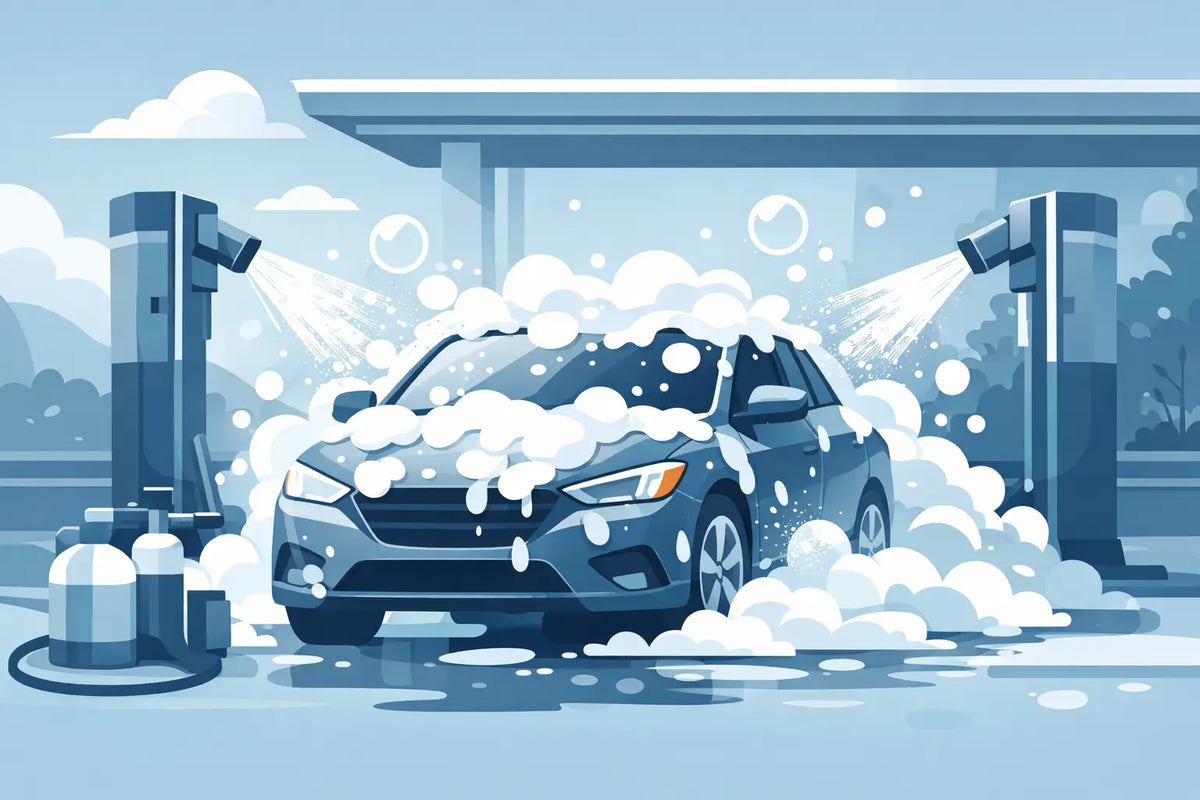
A wash mitt should never be the first thing to touch a dirty vehicle. That is the point of a proper touchless pre wash process: remove as much bonded road contamination as chemistry and water pressure can safely shift before physical contact begins. Get this stage right and the contact wash becomes safer, faster and far more controlled.
This is not about chasing foam for photographs. It is about reducing the abrasive load sitting on paint, gloss black trim, wheels and protection. ZERO HYPE. PURE CHEMISTRY.
What the touchless pre wash process is designed to remove
A vehicle comes back from the road carrying more than visible mud. Traffic film is a layered mix of oily deposits, soot, tyre residue, mineral dirt and general road grime. On lower panels and the rear of the car, it can cling hard enough that plain water will barely affect it.
A touchless pre wash process uses a targeted cleaner, adequate dwell time and a thorough rinse to loosen and remove that contamination without a mitt, brush or sponge. It is an essential risk-reduction stage, not a promise that every vehicle will emerge completely clean without contact.
That distinction matters. A well-maintained car with fresh protection may lose most of its visible dirt during pre-wash. A neglected daily driver, a white van with heavy film, or a vehicle following a wet motorway journey will still need a careful contact wash afterwards. The objective is to remove the dirt most likely to cause wash-induced marring.
Why pre-wash chemistry matters more than foam thickness
Foam is a delivery method. It is not a performance metric.
A dense blanket can look impressive, but the meaningful questions are simpler: does the product wet the contamination, break its bond with the surface and remain active long enough to rinse cleanly? A good pre-wash formula needs surfactants to lift grime, appropriate alkalinity or pH balance for the soil type, and controlled dwell so it works without drying onto the panel.
For general maintenance, a quality traffic film remover is often the strongest first move. It is designed to deal with the oily, electrostatically charged grime that accumulates during normal road use. Snow foam can then add further cleaning and lubrication, especially across broad painted surfaces. Used together, they are a system - not two versions of the same step.
Overusing aggressive chemistry is not disciplined detailing. Strong alkaline products can be useful on heavily soiled vehicles, but repeated heavy dosing can compromise weak protection, dry sensitive exterior trim and create unnecessary runoff issues. Match the product strength and dilution to the vehicle in front of you.
Read the vehicle before you mix the product
Start with the lower doors, sills, rear bumper, wheels and wheel arches. These areas tell you how much cleaning power is needed. If the car has light dust and rain spotting, a mild pre-wash at a sensible dilution may be enough. If the lower half is brown with traffic film, increase concentration within the product guidance or use a dedicated traffic film remover first.
Protection status also changes the decision. A healthy ceramic coating or sealant should be maintained with effective but sensible chemistry. If water behaviour has dropped off, do not automatically blame the coating. It may be clogged with road film. A controlled pre-wash can restore its apparent performance by removing the contamination masking it.
The correct touchless pre wash process
Work on cool panels, out of direct sun where possible. Heat accelerates drying, and dried cleaner is not evidence of extra cleaning power. It is simply harder to rinse and can leave residue.
1. Rinse away loose grit first
Use a pressure washer to remove loose mud, grit and salt. Begin at the lower sections, wheel arches and behind the wheels, then work around the vehicle with a sensible distance from the surface. Avoid forcing water directly into damaged seals, badges, fresh stone-chip repairs or vulnerable electrical areas.
This initial rinse is not optional. It removes the larger particles that can interfere with the chemical stage and prevents you from needlessly pushing contamination around with a foam lance.
2. Apply traffic film remover to the dirtiest areas
Apply the pre-wash from the bottom upwards. This keeps the lower panels wet for longer and helps avoid product running down and becoming diluted before it has worked. Cover sills, lower doors, rear bumper, front bumper, arches and wheels thoroughly, then extend coverage across the rest of the bodywork where required.
Do not mistake more product for better process. Even coverage at the correct dilution is more effective than flooding the panel with an overly concentrated mix. For professional detailers, this is where consistency protects margins as well as paintwork.
Allow the product to dwell according to conditions. In cool, damp weather, it may remain active for several minutes. On a warm, breezy day, monitor it constantly and rinse earlier. Never let pre-wash dry on the vehicle.
3. Add snow foam when the vehicle needs a second cleaning phase
Snow foam is useful after a traffic film remover where the surface still carries visible grime or when you want longer dwell across the full vehicle. Apply it evenly, again working from the lower areas upwards. The foam should cling long enough to clean, then slowly soften and carry contamination down the panel.
On lightly soiled, regularly maintained cars, a single suitable pre-wash product may be all that is needed before rinsing. On heavily contaminated vehicles, the two-stage approach is more reliable. Chemistry made clear: use each product for the soil it is built to remove.
4. Rinse thoroughly from top to bottom
Once dwell is complete, rinse from the roof down. This carries loosened contamination away from the cleanest areas and prevents dirty solution settling back onto the lower panels. Pay close attention to panel gaps, fuel fillers, number plates, grilles, mirrors, arches and badges, where product and dirt can hide.
A thorough rinse is where the touchless stage proves its value. Inspect the paint as water sheets away. If the majority of road film has gone, the next contact stage will be significantly safer. If dirt remains, do not reach for the mitt yet. Repeat a controlled chemical stage or reassess the contamination.
Wheels, arches and awkward areas need their own plan
Wheels are often the dirtiest part of the car, and they should be treated as such. Use dedicated wheel chemistry where necessary, particularly for baked-on brake dust, and clean wheels before the bodywork if heavy contamination is likely to splash. Brushes still have a place inside barrels, around calipers and within intricate wheel faces, but only after a touchless rinse has removed loose grit.
Wheel arches, tyres, grille openings and rear diffuser sections also need attention. A pre-wash will shift a lot, but these areas may need separate agitation due to their shape and accumulated contamination. The rule remains the same: chemical removal first, mechanical contact second.
Common mistakes that reduce results
The biggest mistake is treating pre-wash as a decorative foam stage and moving on before the chemistry has had time to work. Rushing dwell leaves contamination on the paint. Letting product dry creates a different problem altogether.
Another common failure is using one dilution for every vehicle, every day of the year. Water quality, temperature, dirt load and protection condition all affect results. A disciplined process adjusts to conditions without becoming complicated.
Pressure washer technique matters too. Holding the nozzle too close can stress decals, damaged lacquer edges and delicate trim. Standing too far away reduces cleaning force. Use a controlled fan pattern, keep moving and allow the product to do the hard work rather than relying on brute pressure.
Finally, do not use a contact wash as an excuse to skip the pre-wash. A lubricated shampoo helps during hand washing, but it cannot turn grit into a safe surface to touch. Every particle removed beforehand is one less particle available to mark the finish.
When touchless cleaning is enough - and when it is not
Touchless cleaning alone can be enough for a lightly dusty car, a protected show vehicle between events or a maintenance wash where the paint is genuinely free from bonded grime. It is also useful when time is limited and the aim is to remove fresh road dirt without unnecessary contact.
For most vehicles, however, it is preparation. Mineral deposits, stubborn bug residue, tar, iron fallout and static grime can remain after pre-washing. These require the appropriate next step: a safe contact wash, targeted fallout removal, tar treatment or clay decontamination where justified.
The process is not about avoiding contact at all costs. It is about making every necessary contact as safe as possible. Build the wash around contamination, not habit. When the mitt finally reaches the paint, it should be meeting shampoo and clean clearcoat - not a layer of motorway grit waiting to become marring.
A proper pre-wash costs a few more minutes. It can save hours of correction work later. That is a trade worth making on every vehicle that matters.
Share:
Alkaline Shampoo vs Neutral Shampoo for Cars
8 Top Pre-Wash Mistakes That Mark Your Paint