

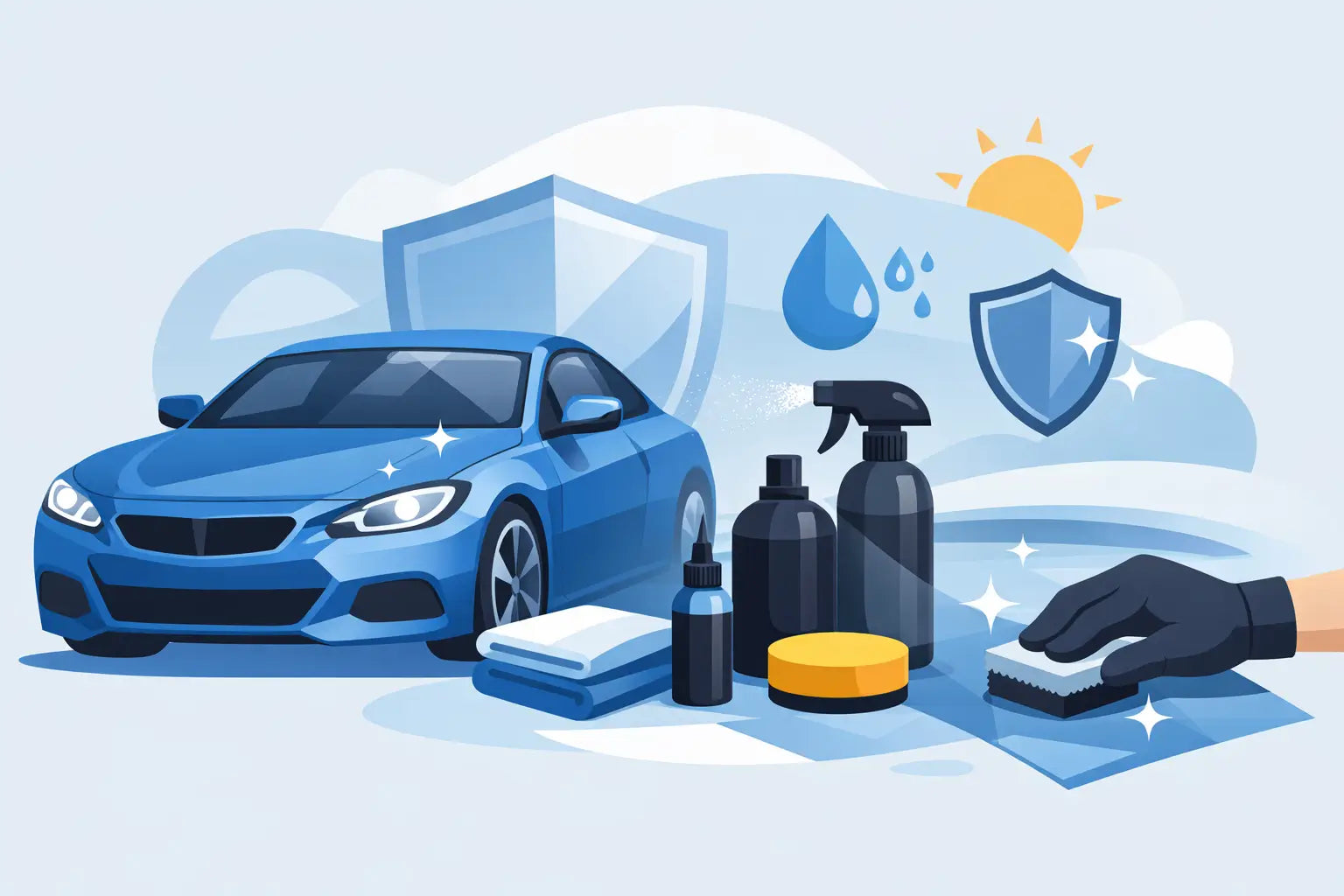
Most protection fails before it ever meets the paint. Poor prep, rushed application and inflated claims are the usual culprits. If you are comparing paint protection products, the real question is not which label sounds toughest. It is which chemistry fits the vehicle, the usage, the prep standard and the person applying it.
That matters whether you are running a detailing business or protecting your own car properly. A daily driver parked outside all year needs a different approach from a weekend car that sees careful maintenance washes. The best result comes from matching the product to the job, not chasing the loudest promise on the bottle.
What paint protection products are meant to do
At a basic level, paint protection products create a sacrificial layer between the clear coat and the outside world. That layer is there to reduce direct contact with contamination, make washing easier and help the finish hold its gloss for longer. Done properly, protection improves maintenance. It does not make paint invincible.
This is where a lot of confusion starts. Protection products can improve chemical resistance, hydrophobic behaviour, slickness and UV stability, but none of that means scratch-proof. Road film still lands on the surface. Wash marring is still possible. Bird lime still needs removing quickly. Serious buyers already know this, but the market still pushes too many miracle claims.
A good protection product should be judged on a few things that actually matter - durability in real conditions, ease of application, cure behaviour, resistance to detergents, and how predictable it is once it is on the vehicle. If those points are vague, the marketing is doing more work than the chemistry.
The main types of paint protection products
Not every protection layer belongs in the same conversation. There are overlapping categories, but each one serves a different level of user and maintenance plan.
Spray protectants and maintenance toppers
These are the quickest products to apply and the easiest to live with. They are ideal for enthusiasts who want fast gloss, beading and easier drying, or for detailers adding short-term protection during maintenance work. Used correctly, they can be excellent value because they are fast, forgiving and simple to refresh.
The trade-off is durability. A spray-applied protectant will not generally hold up like a dedicated sealant or ceramic coating, especially through repeated contact washes, traffic film removers and winter mileage. That is not a weakness if you understand the category. It is a short-cycle product designed for convenience.
Synthetic sealants
Sealants sit in the middle ground. They normally offer better longevity than quick-detail style protection and are often easier to apply than true coatings. For many users, this is the sensible sweet spot. You get meaningful protection, decent chemical resistance and strong water behaviour without the tighter application window and cure demands of a coating.
For trade work, sealants can make commercial sense. They are quicker to install, easier to price into enhancement details and often a better fit for customers who want noticeable results without paying for a long-term coating package.
Ceramic coatings
Ceramic products are where performance claims get serious, but so do the consequences of bad prep. A proper coating can offer strong durability, better resistance to chemical attack, easier maintenance and a more stable protective layer than simpler products. Applied to well-corrected paint, they give a sharper, cleaner finish and reduce how stubborn contamination feels during routine washing.
They are not magic. A coating does not replace wash discipline. It does not stop stone chips. It does not mean the vehicle can be neglected. What it does do is improve the behaviour of the surface in a measurable way when the chemistry is sound and the install is controlled.
Choosing the right paint protection products
There is no single best product for every car. There is only a best fit for the conditions.
If the vehicle is a hard-used daily, ease of maintenance matters as much as headline durability. A product that survives the real wash routine is worth more than one with impressive claims but poor user tolerance. If the car is maintained by a professional or careful enthusiast, a ceramic coating starts to make stronger sense because the maintenance process will support it.
Mileage, storage and climate all matter. A garaged performance car used occasionally can retain protection far longer than a family car doing motorway miles through winter grit and repeated detergent exposure. The owner matters too. If the person washing the vehicle uses poor technique, no product category will compensate for that.
Budget is part of the conversation, but not in the simplistic way it is often framed. Cheap protection that needs constant redoing can cost more in time and effort. Equally, paying for a premium coating without the prep standard to support it is wasted money. Protection should be chosen as part of a system, not as an isolated purchase.
Prep decides the result
This is the least glamorous part of protection and the most important. If the surface still carries bonded contamination, polishing oils, residue or water spotting, the protection layer is already compromised. Performance starts with the wash stage, then decontamination, then panel wipe or the appropriate surface preparation for the chosen product.
On coated jobs, paint correction is often the dividing line between an average result and a proper one. Protection locks in the finish underneath. If the paint still shows haze, marring or poor clarity, the coating will not hide it. It will preserve it.
The disciplined route is slower, but it is the only route that makes sense. Good chemistry needs a clean substrate. There is no shortcut around that.
Application is where honesty matters
One reason the market gets noisy is that many products are sold as easy when they are only easy under controlled conditions. Temperature, humidity, panel temperature and lighting all affect behaviour. Flash times change. Levelling changes. Wipe-off changes. If the product information ignores that, it is not written for serious users.
A reliable protection product should have a clear application method and a manageable working window. That does not mean it needs to be foolproof for everyone. It means the product behaves consistently enough for trained hands and informed enthusiasts to trust it.
This is also where cure time matters. Fast initial cure can be useful, especially in trade settings, but only if the coating still develops properly and reaches its claimed performance. Longer cure can be acceptable if it is disclosed clearly. Precision beats hype every time.
Durability claims need context
A product claiming three years of protection may technically achieve that under ideal maintenance. That is not the same as three years of peak water behaviour on a car used daily through British weather. The honest view is that durability depends on environment, wash frequency, chemical exposure and how the car is maintained.
For professionals, that means managing customer expectations properly. For enthusiasts, it means buying with a realistic plan. If a product gives consistent real-world protection and can be maintained without drama, that is better than a bigger number with weak follow-through.
Brands worth taking seriously are specific about what their products resist, how they should be maintained and what conditions affect performance. That level of clarity is not overkill. It is proof that the chemistry has been thought through.
Maintenance after protection
Protection is not the end of the job. It changes the maintenance routine, ideally for the better. A protected car should wash more easily, dry more cleanly and resist the build-up of contamination more effectively. But the maintenance products still need to be compatible.
Strong cleaners used carelessly can shorten the life of weaker protectants and dull the behaviour of stronger ones. Aggressive contact washing can still mark the paint. Topping products can help, but only if they are chosen to support the base layer rather than mask declining performance with temporary gloss.
This is why chemistry-first systems make sense. Pre-wash, shampoo, decontamination and maintenance protection should work together, not fight each other. It keeps decisions simpler and results more predictable.
For serious users, that predictability is the point. Whether you are maintaining customer cars or your own, you want products that behave properly, tell the truth and perform under normal use. That is where brands like Liquid Laboratories have an advantage when they focus on engineered formulations instead of lifestyle noise.
Paint protection is not about chasing the hardest claim or the slickest label. It is about selecting chemistry that fits the job, preparing the surface properly and maintaining the finish with the same level of discipline. Get those three parts right and the gloss is only the visible part of the result.
Share:
Detailing Chemistry Innovations That Matter
How to Choose Snow Foam That Actually Works