

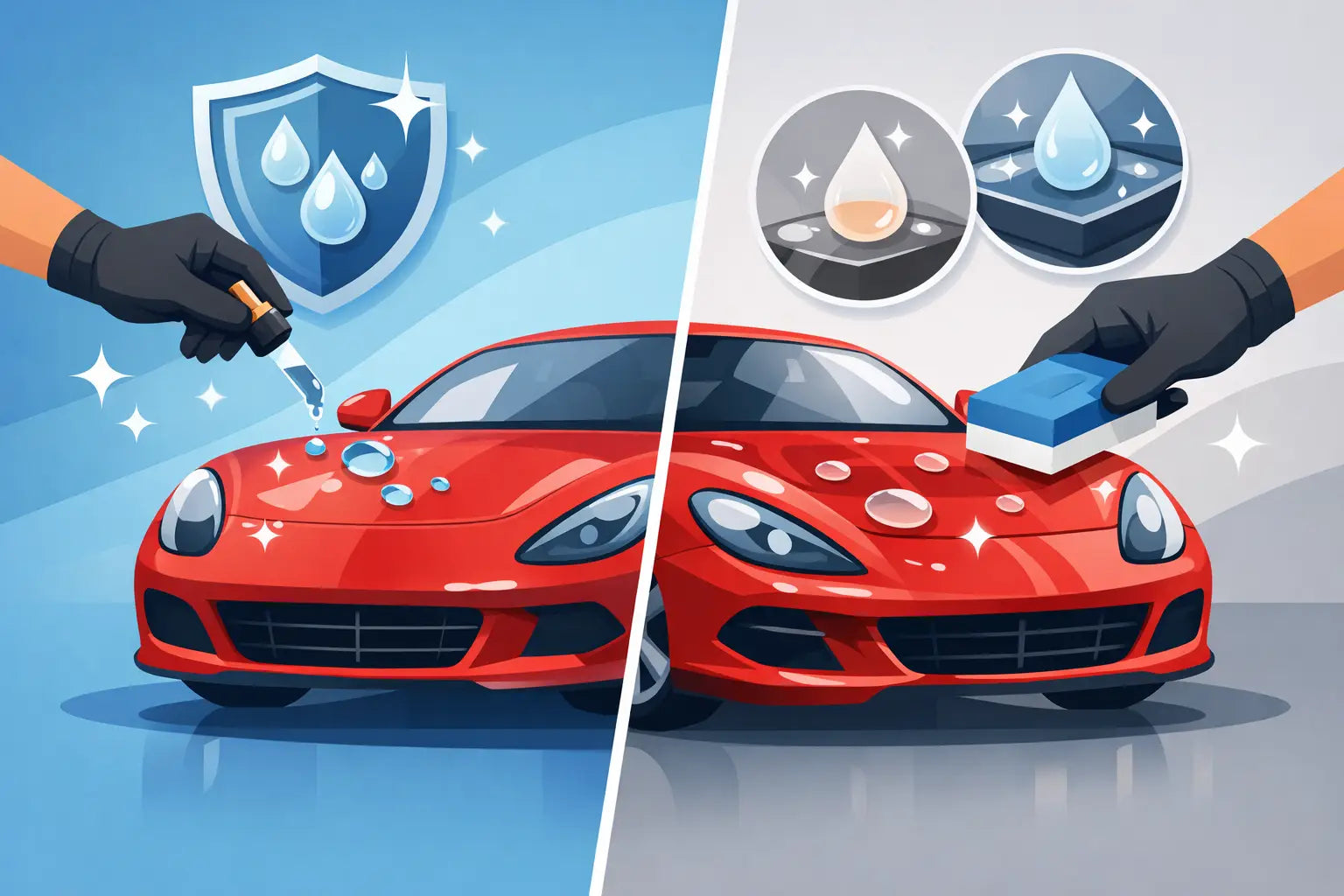
A lot of paint protection decisions get made on the wrong metric. People chase the biggest durability claim on the label, then ignore prep, application conditions, maintenance, and how the vehicle is actually used. That is where ceramic coating vs sealant becomes a practical question, not a marketing one.
Both products exist to do a job. They create a protective layer over the paint, improve water behaviour, reduce contamination sticking to the surface, and make maintenance easier. But they do not behave the same way, they do not last the same length of time, and they are not aimed at exactly the same user.
Ceramic coating vs sealant: the core difference
The shortest answer is this. A ceramic coating is a more durable, more chemically resistant, longer-term protective layer that usually demands better prep and tighter application control. A sealant is quicker, simpler, and more forgiving, but it will not usually match a coating for lifespan or resistance.
That matters because protection is never just about shine. It is about how the surface deals with wash cycles, road film, bird lime, UV exposure, winter salt, detergent contact, and day-to-day abuse. If you are working on a client car, a daily driver, or a weekend car that only comes out in fair weather, the right product depends on the job.
What a sealant does well
A good synthetic sealant gives paintwork a clear, slick sacrificial layer. It boosts gloss, improves hydrophobic behaviour, and makes drying easier. For many enthusiasts, that is more than enough. For many trade jobs, it is also the right commercial answer.
Sealants tend to be easier to apply and easier to reapply. That has value. If you maintain your car regularly and do not mind topping up protection every few months, a sealant can make perfect sense. It is especially useful for owners who want visible results without committing to coating-level prep and cure discipline.
There is also less risk. Application is generally more forgiving, high spots are less of a concern, and working time is usually broader. On busy workshop days or mobile jobs where conditions are less controlled, that simplicity can outweigh the shorter durability.
What a ceramic coating does differently
A ceramic coating is built for longer service life and stronger performance under harsher conditions. Done properly, it forms a more resilient layer than a conventional sealant. That usually means better resistance to chemicals, UV degradation, environmental fallout, and repeated washing.
It also tends to hold its behaviour longer. A fresh sealant can look excellent, but coatings are designed to keep performing after months of use, not just the first few washes. Water behaviour stays sharper for longer, contamination release is better, and maintenance becomes more efficient over time.
That does not mean coatings are magic. They do not stop stone chips. They do not make paint scratch-proof. They do not remove the need for safe washing. Anyone selling that idea is selling noise, not chemistry.
Durability claims need context
This is where a lot of the confusion starts. A sealant may be quoted at a few months. A coating may be quoted at one, three, or even five years. On paper, the answer looks obvious.
In reality, durability depends on prep quality, panel condition, storage, mileage, wash routine, climate, detergent strength, and whether the vehicle is decontaminated and maintained correctly. A coating on poorly prepared paint can underperform. A well-maintained sealant on a garaged car can look better than a neglected coating on a daily driver.
So yes, ceramic coatings generally last longer. But longer only matters if the installation and aftercare support the chemistry.
Gloss, slickness and finish
Some users expect a coating to transform paint by itself. It will not. The finish you see after protection mostly comes from what sits underneath. If the paint has been corrected properly, cleansed properly, and stripped of residues, both a sealant and a coating can look outstanding.
The difference is usually in character rather than a dramatic night-and-day result. Sealants often give a slick, bright, glossy finish that feels immediately impressive. Coatings can deliver a sharper, more glass-like look with strong clarity and tighter water behaviour. Which you prefer can come down to the paint colour, the product chemistry, and your expectations.
If the paint is swirled, oxidised, or full of defects, neither product is a substitute for correction. Protection locks in the condition you leave behind.
Application: where the gap gets real
Sealants are easier to live with
For enthusiasts working at home, sealants are often the safer choice. They are quicker to apply, more tolerant of minor mistakes, and less demanding in terms of temperature, humidity, and wipe timing. That means less risk of frustration and less chance of chasing application marks around the car.
For maintenance details and fast-turnaround jobs, that ease matters. You can deliver strong gloss and respectable protection without tying up the vehicle for extended cure time.
Coatings demand more discipline
Ceramic coatings ask more from the installer. Paint prep needs to be right. Residues need to be removed fully. Application needs control. Levelling needs to be correct. Cure conditions matter. If you cut corners, the result shows.
That is why coatings suit detailers and serious enthusiasts who understand the full workflow. The product itself is only part of the result. Prep, environment, and method are the rest.
Ceramic coating vs sealant on maintenance
Once installed, both options should make washing easier. Dirt releases more readily, rinse performance improves, and drying becomes cleaner. But coatings usually hold that advantage for longer.
A sealant can start strong and taper off faster, especially through winter or on high-mileage vehicles. It may need more regular top-ups to stay at peak performance. That is not a flaw. It is just part of the ownership model.
A coating is better suited to owners who want a longer maintenance cycle and a surface that keeps resisting contamination after repeated wash exposure. For trade customers managing client expectations, that longer-term consistency can be a major selling point.
Cost is not just the bottle price
If you compare only the upfront price, sealants usually look better value. They cost less to buy and often less to apply. For many cars, that makes them the sensible answer.
But real cost includes labour, correction time, reapplication frequency, and the standard of finish expected. A coating may cost more initially, but on vehicles kept long term, or on client cars where premium protection is part of the service, that cost can be justified.
The opposite is also true. Putting a multi-year coating on a car that gets poor wash maintenance, sees automatic car washes, and is being sold in six months may not be smart detailing. The right protection should match the ownership pattern.
Which one should you choose?
If you want maximum durability, stronger chemical resistance, and a more professional long-term protection package, choose a ceramic coating. It is the stronger technical solution when the prep and installation are done properly.
If you want easier application, lower upfront cost, and solid real-world protection that you are happy to refresh more often, choose a sealant. It is not the lesser option. It is simply the more flexible one.
For professionals, the decision often comes down to service structure. Not every customer needs or wants a coating package. A quality sealant can be the right fit for enhancement details, dealer work, maintenance plans, or budget-conscious clients. For enthusiasts, it comes down to how much time you want to invest now versus later.
The mistake to avoid
Do not buy protection based on hype words alone. Hardness ratings without context, inflated longevity claims, and vague promises about permanent shine do not tell you enough. What matters is how the product performs in a full detailing system, how predictable it is to apply, and how honestly its limitations are presented.
That is why chemistry-first brands matter. Liquid Laboratories builds around performance, usability, and clear claims because serious users do not need theatre. They need products that behave properly on paint.
If you are choosing between ceramic coating and sealant, be honest about the car, the environment, the budget, and your maintenance habits. The best protection is not the one with the loudest label. It is the one that fits the job and keeps delivering after the first wash.
Share:
Ceramic Coating Preparation Guide That Works
How Long Does Ceramic Coating Last?